What New York employers need to know about workplace Narcan requirements, employee training, supply placement and emergency preparedness.
New York State is taking another step toward improving workplace emergency preparedness with a new law requiring certain employers to make an opioid overdose-reversal medication available at the workplace.
Beginning December 12, 2026, New York Labor Law § 27-f will require covered employers to have an opioid antagonist, such as naloxone (commonly known by the brand name Narcan), available for workplace first aid or emergency treatment.
The New York State Department of Labor has also proposed regulations outlining how employers would implement these requirements, including medication quantities, accessibility, employee training and ongoing inspections.
For business owners, facility managers, HR professionals and safety coordinators, the questions are important: Does this law apply to my workplace? What supplies will I need? Will employees need training? And what should my organization do before the deadline?
Here's what New York businesses need to know and how they can begin preparing.
1. Who Does the New York Narcan Law Affect?
New York Labor Law § 27-f applies to employers that are required under federal OSHA requirements and applicable safety standards to have first aid supplies readily available for the treatment of injured employees.
The coverage determination is based on applicable workplace safety requirements, not simply whether a business voluntarily maintains a first aid kit.
For example, OSHA's general industry standard, 29 CFR § 1910.151(b), addresses the availability of medical personnel for advice and consultation and adequate first aid supplies when an infirmary, clinic or hospital is not in near proximity to the workplace.
This means employers should evaluate their actual workplace circumstances rather than assume that a particular industry or business environment is automatically covered or exempt.
Businesses That Should Review Their Requirements
The following businesses and facilities should evaluate whether the law applies to their workplaces:
- Office buildings and professional offices: Businesses should evaluate their workplace first-aid obligations rather than assume that an office environment is exempt.
- Warehouses and distribution centers: Facilities where employees work around equipment, materials and other potential workplace hazards.
- Manufacturing and industrial facilities: Workplaces with established first-aid and emergency response procedures.
- Construction and trade businesses: Employers should assess their applicable OSHA first-aid requirements.
- Retail stores and commercial businesses: Lower-risk environments should not automatically assume they are exempt.
- Restaurants, hotels and hospitality businesses: Employers should review their workplace obligations and any additional requirements that may apply.
- Businesses operating multiple locations: Each workplace should be evaluated based on its individual circumstances.
Important: This is an illustrative list, not a determination that every business in these categories is covered. The applicable OSHA requirements and workplace circumstances determine whether the law applies.
What About Bars and Businesses That Serve Alcohol?
Businesses that serve alcohol should pay particular attention because there are separate provisions addressing opioid overdose preparedness at certain nightlife establishments.
New York Public Health Law § 3309 directs the state to establish guidelines for onsite opioid overdose response capacity at qualifying nightlife establishments.
These provisions are separate from the workplace requirements established under Labor Law § 27-f.
Bars, nightclubs, entertainment venues and qualifying restaurants should review both sets of requirements, along with any applicable local regulations.
2. What Does the New Law Actually Require?
At its core, Labor Law § 27-f requires covered employers to have an opioid antagonist available for workplace first aid or emergency treatment.
Naloxone is a medication that can temporarily reverse the effects of an opioid overdose, helping restore normal breathing while emergency medical services are contacted.
However, simply purchasing a Narcan kit is not the same as having an effective workplace response plan.
The Department of Labor's September 2026 proposed regulations provide additional guidance on several important areas.
A. Maintain an Appropriate Supply of Naloxone
Employers will need to determine an appropriate quantity of opioid antagonists for each covered workplace.
The proposed regulations do not establish one universal number of doses for every business. Instead, employers would evaluate factors such as:
- The size and physical layout of the workplace.
- The number of people who work at or otherwise access the location for work-related purposes.
- Whether higher-risk populations access the workplace.
- The nature of the work being performed.
- Any history of suspected overdoses at the workplace.
Businesses operating multiple locations should evaluate supply needs separately rather than assuming every facility requires the same quantity.
B. Ensure Supplies Are Accessible
In an emergency, employees need to know where emergency supplies are located and how to retrieve them quickly.
The proposed regulations address appropriate placement and accessibility of naloxone supplies.
Employers should consider:
- Placing supplies in an accessible, clearly identified location.
- Ensuring employees can quickly identify and retrieve the medication.
- Avoiding unnecessary barriers that could delay an emergency response.
- Addressing security and storage concerns.
- Communicating the location of supplies to employees.
The proposed regulations also address storage in the manufacturer's original sealed packaging, together with the applicable instructions.
Does Narcan Need to Be Stored Inside a First Aid Kit?
The statute requires an opioid antagonist to be available at the workplace but does not specifically require Narcan to be stored inside an existing first aid kit.
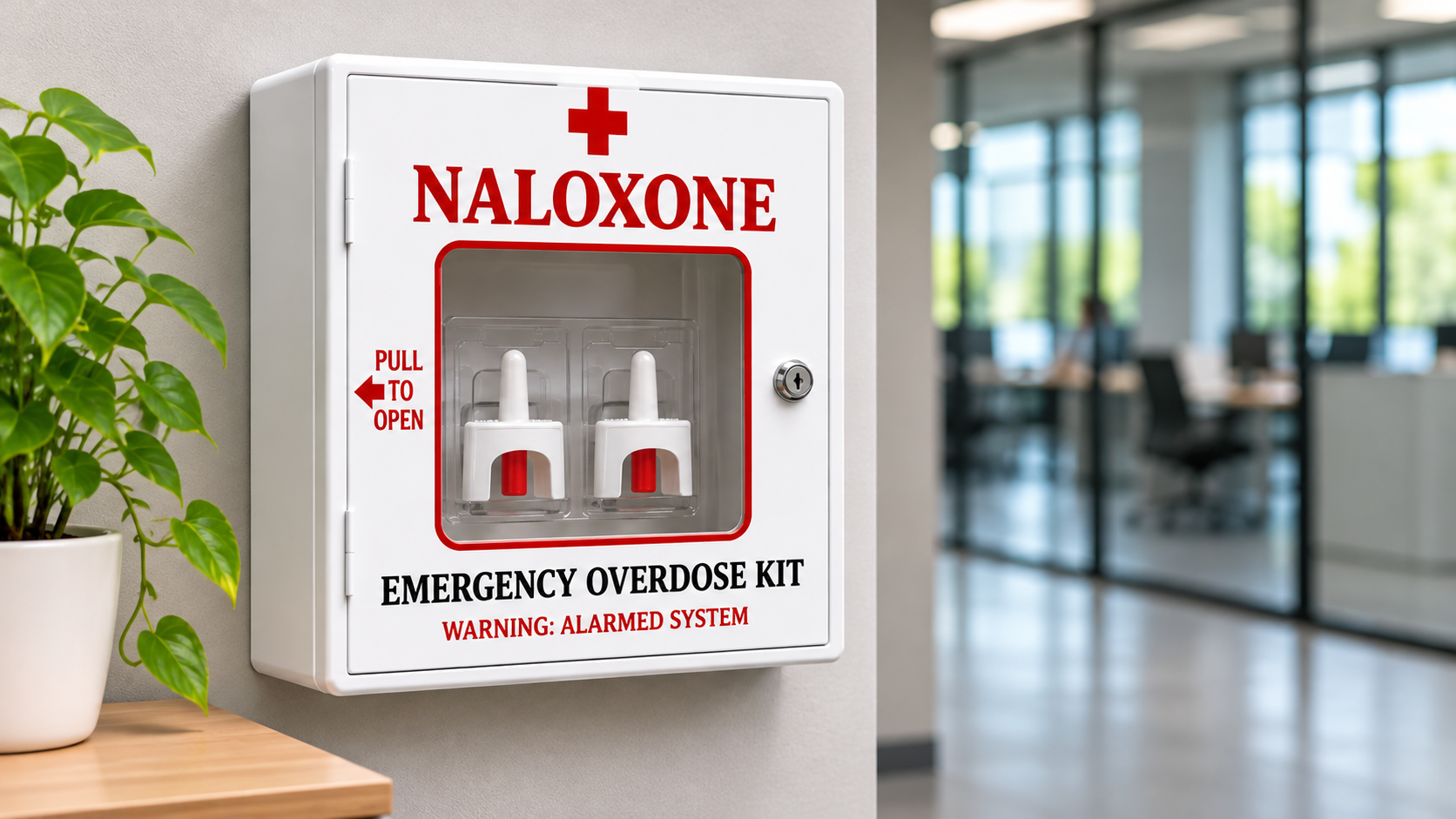
For the purpose of clear identification and accessibility during an opioid emergency, we strongly recommend storing Narcan in a separate, clearly labeled and easily accessible location. Employees should be able to identify and retrieve the medication immediately without having to search through an entire first aid kit.
When seconds matter, knowing exactly where emergency medication is located can make a critical difference. Clear labeling and designated storage help eliminate confusion and support a faster, more organized emergency response.
C. Establish an Employee Training Plan
Having Narcan available is only one part of an effective emergency response program. Employees also need to understand how to recognize a suspected overdose and respond appropriately.
The proposed regulations address employee training and call for employers to make reasonable efforts to recruit employee volunteers.
Importantly, the proposed rules also call for at least one trained employee to be present in the workplace during business hours.
Training topics include:
- Recognizing the signs and symptoms of an opioid overdose.
- Understanding when naloxone may be needed.
- Properly administering the medication.
- Appropriate actions before and after administration.
- Contacting emergency medical services.
- Understanding applicable Good Samaritan protections.
Employers should consider training multiple employees, particularly in workplaces with several shifts or extended operating hours, to help maintain trained coverage.
The proposal does not require every employee to volunteer or compel an employee to administer the medication.
D. Inspect and Replace Supplies
Like AED pads, batteries and other emergency medical supplies, Narcan requires ongoing attention.
The proposed regulations address the inspection and replacement of medication that is expired, missing, tampered with or otherwise unusable.
Employers should establish a process for:
- Checking expiration dates.
- Confirming supplies remain sealed and usable.
- Replacing missing or used medication.
- Addressing damaged or tampered-with packaging.
- Properly disposing of expired or used products.
A designated person should be responsible for monitoring supplies and arranging replacements when necessary.
Although the proposed regulations do not establish a specific inspection frequency, having a consistent inspection schedule can help prevent supplies from becoming unavailable when needed.
E. Consider Shared Workplace Arrangements
Some businesses operate in shared facilities where multiple employers occupy the same building or workplace.
The proposed regulations address situations where multiple employers may jointly satisfy the requirements through a documented shared compliance arrangement.
This arrangement would need to be memorialized in a written plan and made available to the Department of Labor upon request.
Employers sharing a workplace should clearly establish responsibilities for maintaining supplies, employee communication, training coordination and ongoing inspections.
3. How Can Your Business Prepare for Compliance?
Businesses do not need to wait until December to start reviewing their emergency preparedness.
Taking a proactive approach now can help organizations identify gaps, plan purchases and establish procedures before the effective date.
Here are seven practical steps to get started.
Step 1: Determine Whether Your Workplace Is Covered
Review your applicable OSHA first-aid requirements. If your organization operates multiple facilities, evaluate each workplace individually.
If coverage is unclear, consult a qualified workplace safety professional or legal adviser.
Step 2: Review the Final Regulations
The Department of Labor published proposed regulations in September 2026, with public comments scheduled to close November 22, 2026.
As of November 3, 2026, the regulations remain proposed and may change before final adoption. Employers should monitor the Department of Labor for updates before establishing their final compliance policies.
Step 3: Evaluate Your Existing Emergency Supplies
Review your current first aid kits, AED locations, emergency response procedures and other workplace safety resources.
Consider where Narcan could be stored so employees can retrieve it quickly when needed.
Step 4: Determine Your Naloxone Supply Needs
Evaluate the size and layout of each covered workplace, the number of individuals accessing the facility and the other factors identified in the proposed regulations.
Avoid assuming that every location requires the same number of doses.
Step 5: Establish an Employee Training Plan
Identify employees who may be willing to receive opioid overdose response training.
Consider providing training to multiple employees to help maintain coverage during business hours, across shifts and during employee absences.
Step 6: Create an Inspection and Replacement Schedule
Assign responsibility for checking expiration dates, confirming supplies remain accessible and usable, and arranging replacements when necessary.
Adding Narcan to your existing workplace safety inspection process can help ensure supplies remain ready for an emergency.
Step 7: Document Your Emergency Preparedness Procedures
Establish clear procedures for locating supplies, contacting emergency responders, administering naloxone and replacing used medication.
For businesses sharing a workplace, determine whether a documented joint compliance arrangement is appropriate.
Documenting your organization's preparedness efforts can also help keep responsibilities clear.
4. What Should Businesses Do Right Now?
With the December 2026 effective date approaching, employers should begin evaluating their current workplace safety programs.
Here are five priorities:
- Review workplace coverage: Determine whether your organization is subject to the OSHA first-aid requirements that trigger the new law.
- Evaluate emergency supplies: Review your existing AEDs, first aid kits and other emergency response equipment.
- Plan your Narcan supply: Identify appropriate products, quantities and accessible storage locations.
- Prepare for employee training: Identify employees who can receive training and help support workplace emergency response.
- Establish ongoing maintenance: Assign responsibility for inspections, expiration monitoring and replacement supplies.
Businesses that operate multiple locations should also consider establishing a consistent process for monitoring emergency equipment across their facilities.
5. Frequently Asked Questions
Does every New York business need Narcan?
Not automatically. The law applies to employers subject to the federal OSHA first-aid requirements specified in Labor Law § 27-f. Each workplace should be evaluated based on its applicable requirements.
Does having a first aid kit automatically mean Narcan is required?
Not simply because a business voluntarily maintains a first aid kit. The relevant question is whether the employer is required under applicable federal OSHA standards to have first aid supplies readily available.
Does Narcan need to be stored inside a first aid kit?
The statute requires an opioid antagonist to be available at the workplace. It does not specifically require Narcan to be placed inside an existing first aid kit. A separate, clearly labeled and accessible storage location is a practical recommendation to help employees locate the medication quickly during an emergency.
Does a business that serves alcohol automatically have to comply?
Serving alcohol alone is not the trigger under Labor Law § 27-f. Certain nightlife establishments may be subject to separate overdose-response guidelines or other applicable requirements.
How many doses must a workplace have?
The proposed regulations use a workplace-specific assessment rather than establishing one fixed quantity for every employer. Employers should review the final regulations when determining their supply needs.
Does every employee have to be trained?
The proposed regulations address recruiting employee volunteers and call for at least one trained employee to be present during business hours. Employers should review the final regulations for the precise requirements.
What happens if multiple businesses share the same workplace?
The proposed regulations allow multiple employers sharing a workplace to establish a joint compliance arrangement through a written plan. The arrangement should clearly identify responsibilities and be available to the Department of Labor upon request.
When does the workplace Narcan law take effect?
New York Labor Law § 27-f lists December 12, 2026, as its effective date.
Preparing for the December 2026 Deadline
Workplace emergency preparedness is an ongoing responsibility. As New York approaches the implementation of its new workplace Narcan requirements, employers should take the time to review their existing safety procedures, evaluate emergency supplies and establish a plan for maintaining accessible, ready-to-use equipment.
Understanding the law, identifying applicable requirements and preparing employees ahead of time can help organizations take a more proactive approach to workplace safety.
Start reviewing your workplace emergency preparedness plan now rather than waiting until the deadline.
Disclaimer: This article is intended for general informational purposes only and does not constitute legal advice. The Department of Labor's proposed regulations may change before final adoption. Employers should consult the current statute, applicable OSHA standards, final regulations and relevant local requirements to confirm their obligations.
Leave a Comment